
Creating a comic with AI is far more hands-on than it seems. Multi-panel AI comics are not generated as complete stories; therefore, it is not a one-click process. The panels are built piece by piece, each meticulously shaped to fit into a larger narrative. The real work is not in generating the outputs, but in compiling them into a coherent form that flows, connects, and tells a story.
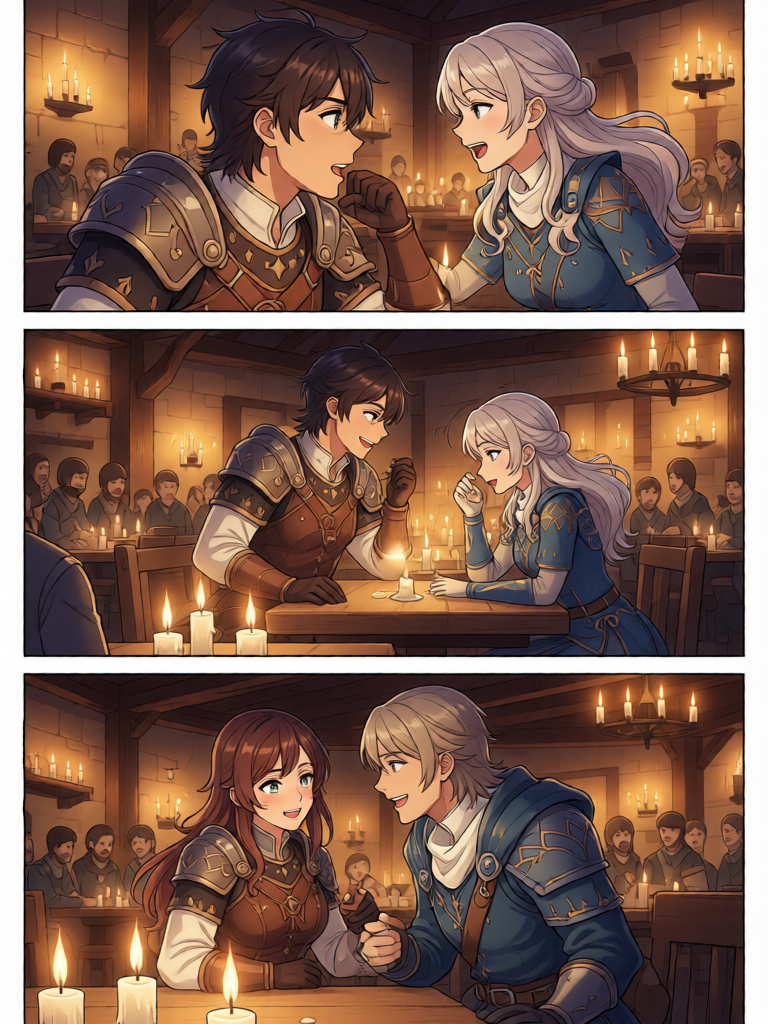
Overview of Multi-Panel AI Comic Generation
Multi-panel comics that are generated with AI are not created as unified outputs, but as a sequence of individually generated images that must be carefully coordinated to function as a coherent narrative.
Each panel of the comic is essentially a standalone image because the system processes prompts with no cognizance of previous or subsequent panels. And, by implication, there is no built-in understanding of continuity, character progression, or story flow. Therefore, what appears as a connected sequence in the final comic is, in fact, the result of consistent inputs, controlled variation, and structured decision-making applied by the creator at every step.
Creators are responsible for constructing that story manually, panel by panel. The AI is just a tool for producing high-quality imagery; it does not organize its results into a narrative. The burden of continuity, of ensuring that the characters remain recognizable, that the scenes transition naturally, and actions unfold as they should, rests entirely on the generation process itself.
In generators such as uncensoredhentai.ai, which emphasize creative freedom and control, this approach is even more relevant because the system only produces detailed, stylized anime artwork. The multi-panel comic creator must, however, orchestrate a sequence of outputs that, when assembled, forms up as a complete story.
Multi-panel AI comic generation is not defined by automation, but by a structured transformation of isolated images into a cohesive narrative experience.
Why AI Struggles with Sequential Storytelling
While AI image generators are capable of producing detailed and stylistic results, they cannot maintain narrative sequences across multiple outputs, and they have no inherent memory of what came before or what is expected to follow.
This absence of continuity stems from how image generation models function primarily. Every prompt is processed as a separate request, so the system does not retain the context from previous panels, and neither does it automatically preserve the elements.
This limitation becomes glaring in sequential storytelling. A character who appears composed in one panel may totally change posture, expression, or even physical features in the next. Some background elements may be removed unintentionally, and the actions can be disjointed. Without deliberate intervention in these cases, the sequence risks losing coherence, and viewers can miss the intended narrative.
In addition, the AI also lacks temporal awareness (i.e., the understanding of time), and it cannot distinguish between “before,” “during,” and “after” within a sequence of events. Therefore, it is the responsibility of the creator to define each moment clearly and ensure that transitions between panels reflect logical progression.
In short, the system provides the tools to generate compelling individual visuals, but sequential storytelling itself emerges only when those visuals are guided with precision.
Transforming Ideas into Panel Sequences through Planning
At its core, planning helps to break down scenes into smaller, manageable moments, where each panel carry out a set action, reaction, or transition. This gives the creator clarity of thought and purpose for the generation process.
Planning also helps to define the pacing of every comic. Not every moment needs to be depicted; however, the key transition moments must be clear. Through planning, creators get to decide where a scene begins, how it will develop, and where it will end, and designate each panel to a set purpose.
More so, consistency in intent and results can also be achieved through planning. In multi-panel AI comic generation, each panel must build on the previous one, even if the AI itself does not recognize the connection. This implies that core elements like pose, expression, or camera angle must be defined and stable from one panel to the next.
In terms of delivery, planning also helps to manage complexity and sequence control, and minimize confusion and guesswork when working on highly detailed scenes. By simplifying each panel into a set moment, the AI will be able to produce more accurate and stable results.
In real use, effective multi-panel generation begins with a clear sequence, not a prompt. The prompts come later, after the plan has been defined and the structure is established.
Generating Panels Step-by-Step: The Sequential Workflow
The sequential approach is a reliable way to make a multi-panel AI comics, because it guides each new panel by what has already been established.
The first panel sets the graphic foundation for everything that follows, including character appearance, style, and overall tone. More so, a well-defined starting point reduces the amount of correction that will be needed as the sequence progresses.
The successive panels can then be generated with reference to the previous one. This does not mean copying the same prompt repeatedly. The core elements (i.e., character identity and style) must be left as they were, while aspects like pose, expression, or camera angle can be modified to reflect the next moment in the sequence.
Since reference images play a key role in every consistent workflow. Previously generated panels are better input as a visual guide for the AI to preserve important details. This will maintain alignment even where well-written prompts fail.
Most importantly, every panel must be reviewed thoroughly, and every inconsistency must be corrected to keep the sequence on track and prevent minor issues from compounding.
Keeping Characters and Scenes Consistent Across Panels
Planning induces order and structure in multi-panel AI comic generation. However, consistency and continuity across panels are what make the comic immersive and plausible.
The core identity of the character must be uniform across the panels. Its visual references must be consistent, and its defining traits unchanged. The goal is to ensure that the character is clearly the same one from one panel to the next — not perfect replication.
Similarly, the backgrounds, lighting, and spatial relationships of the scene must be progressive and fluid, even as the scene evolves, because abrupt changes in environment or perspective can break immersion unless they are intentional.
The transitional logic is just as important. The movement between panels must be natural; otherwise, the sequence will be fragmented. By implication, motion (e.g., the character turning, stepping forward, or reacting) must be gradual, not a sudden, unexplained repositioning.
Moreover, reference usage remains critical even at this stage. By consistently feeding previous panels back into the process, creators simultaneously reinforce both character and scene stability.
Composition Control, Angles, and Visual Flow
The composition of each panel must be resolute because they draw viewers’ attention. Some should establish the scene, some may focus on the character’s expression, and others can highlight a specific action or interactions.
The viewing angles and perspectives add a sense of progression to comics. A wide shot can establish context, a mid-shot can capture interaction, and a close-up can emphasize emotion or detail. This approach mimics traditional comic and cinematic techniques to a fault, and makes the sequence more dynamic.
The visual flow, the transition from one frame to the next, must guide the viewer through the scene and overall narrative without confusion, either by maintaining directional movement or consistent positioning from start to finish.
In short, prompts and references ensure consistency, but the control of angles, framing, and visual emphasis gives the sequence its narrative rhythm.
From Panels to a Finished Comic: Assembly and Final Touches
Once all panels have been generated, refinement is all that is left (i.e., how the panels come together as a unified AI comic). The panels are organized in a clear and readable sequence — assembly. The assembly stage is where the layout, spacing, and arrangement are done to support the flow of the story.
The assembled panels are scrutinized for omissions and inconsistencies, after which selective adjustments (e.g., cropping, alignment, or light editing) are carried out to unify the sequence.
What’s a story without dialogue, and what’s a comic without its captions?! External tools are adopted for text integration because they offer more control over placement, font, and readability.
As final touches, the contrast of the panels can be adjusted and the colour refined accordingly to improve the overall quality of the comic.
In the end, what started as many isolated graphics is transformed into a unified AI-generated comic.