
Webtoon-style AI adult comics are an intersection of style, theme, and technology. On one hand, there is the vertical-scrolling Webtoon format and its pacing workflow. On the other, a mature (adult) theme and a more permissive character dynamics. And when combined with AI generation, the result is a guided process where explicit graphics are created piece by piece and are transformed into an adult Webtoon narrative.
Overview of Webtoon-Style Adult Comics
Webtoon-style adult comics combine a distinct visual format with a more mature approach to storytelling, and they place more emphasis on pacing, transitions, and visual progression.
Moreover, adult-themed contents are based on character interactions, and the storytelling often relies on factors like buildup, subtle shifts in expression, and evolving scenarios across multiple panels.
In addition, format and intent make Webtoon-style adult comics more distinctive. The story progresses as viewers scroll up, and the tone, interaction between characters, and visual clarity of the comic are usually plausible and very convincing. Taken together, they create an immersive adult sequence that unfolds as the viewer scrolls.
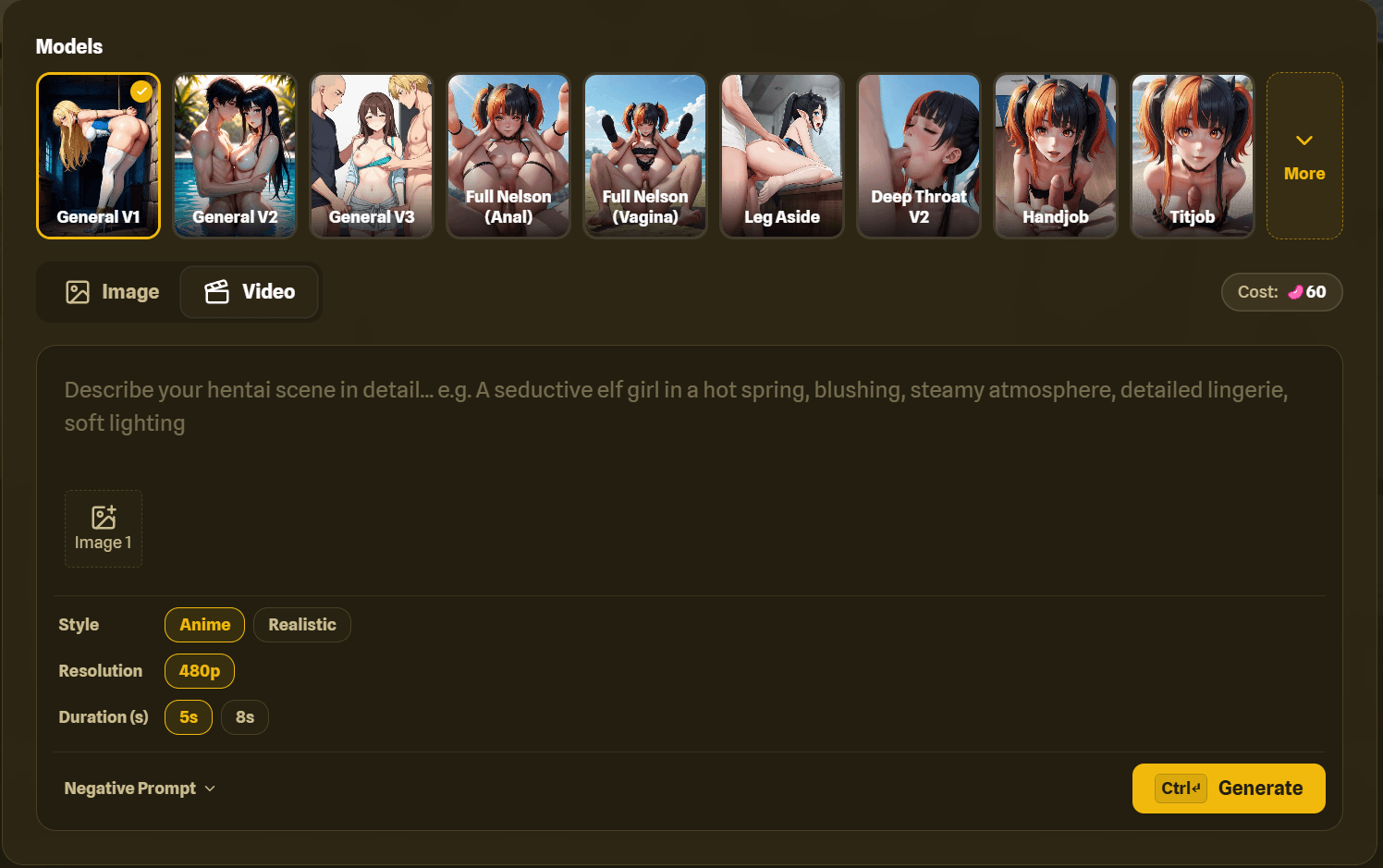
How to Create Webtoon-Style Adult Comics with AI
The process of creating a Webtoon-style adult comic with AI is in phases. It begins with defining what the comic is meant to convey (i.e., its intent, objective, and target audience), then into generating individual panels that reflect that direction, and finally into assembling those panels into a vertical format that unfolds the story.
A key characteristic is that each new step builds on the previous one, and everything is done in sequence. Unlike traditional tools that allow for full-page composition, AI-generated Webtoon comics are created piece by piece, with every panel individually reviewed and positioned within the larger, mature storyline. This step-by-step construction is what makes it possible to control pacing, maintain visual continuity, and guide the viewer’s experience as they scroll.
Moreover, there must be a balance between flexibility and direction. The AI is known for generation speed and results variation, but without a clear structure, that flexibility is pointless. The creation process, therefore, is about managing how those images relate to one another, how they transition, and how they collectively form a coherent sequence.
Seen this way, creating Webtoon-style adult comics with AI is closer to assembling a scroll-based adult-themed narrative than simply generating artwork.
Planning Adult-Themed Narratives for Vertical Storytelling
Planning helps to define the structure of Webtoon adult comics. It is not optional.
Adult-themed storytelling relies on buildup, tension, and the interaction between the subjects. However, these elements and their objectives cannot be expressed as a single scene. Therefore, they must be broken down into smaller, deliberate moments to be delivered across many panels, and each panel must be planned to highlight changes in expression, positioning, and emotional tone.
In addition, creators must identify key points within each scene — beats. These beats coordinate the sequence and also assign a clear purpose to every panel in the sequence. With this, an interaction becomes a moment, a moment evolves into a closer engagement, and an engagement into a reaction or continuation.
Pacing and spacing also play a central role in immersive viewer experience because large gaps create anticipation or pause, while tight sequences represents immediacy or intensity.
Proper planning simplifies everything else that follows. It reduces guesswork during prompting, improves consistency across panels, and makes final assembly more cohesive in Webtoon-style adult comics.
Character Design for Stylized and Consistent AI Output
AI requires that consistency be defined upfront and reinforced throughout the process, and so should the character identity.
Adult comic characters need to be described in a way that captures their defining traits because that would serve as anchors to help the AI reproduce the same character across multiple generations. The more specific and consistent these descriptors are, the more stable the outputs.
In adult-themed content, character design also plays a narrative role. Expression, posture, and visual cues carry more weight, as interactions between characters are central to the scene. This means that the design must support a range of expressions, emotions, and poses in a way that does not reduce recognisability.
Even so, Webtoon-style comics are typically stylized anime aesthetics, and the characters must be designed with that in mind. Nevertheless, the character’s framing, number of appearances, and the extent of interaction in every scene must also be decided during the character design.
Ultimately, character design in AI-generated comics sets the boundaries within which the AI operates consistently.
Prompt Engineering for Adult-Themed Webtoon Panels
In Webtoon-style comics, the prompts are not written in isolation; they are part of a sequence, and each one must build on what came before it.
Having said that, a well-structured prompt typically balances three core elements, namely, the character identity, the scene context, and the panel-specific action. The character identity must remain stable across the panels to reinforce consistency. The scene context has to do with continuity in the environment and tone. The panel-specific actions, however, are preordained activities of the subjects, as well as the progression of the sequence.
The tone and interaction in adult-themed comics are more nuanced. Therefore, the wording must be precise and clear, yet simple. Simpler and focused prompts tend to perform better in sequences.
There must also be continuity between prompts. And, by implication, each new prompt must serve as a natural extension of the previous one, rather than a complete reset.
Generating Panels: Flow, Transitions, and Emotional Continuity in Adult Comics
The panels should be created one at a time, with each output, as a reference for what follows, thereby creating a sense of continuity, even when the AI does not keep track of the previous outputs.
In addition, transitions between panels are equally important. Every change, no matter how trivial, must be intentional (e.g., in pose or expression). More so, abrupt transitions only make the sequence disjointed.
In terms of emotional and visual continuity, however, adult-themed comics depend on subtle cues like expressions, eye direction, and body language to carry the scene forward and onto other panels.
This workflow introduces control into a system that is otherwise unpredictable.
Creating the Webtoon Layout: Scroll, Spacing, and Impact
Composition is how isolated images are transformed into a Webtoon-style comic, and where the storytelling elements come together.
Webtoon uses a vertical format/layout, where the panels are stacked in a single column, and spaced, either with a large gap between two panels to create pauses, anticipation, or emphasis, or a tight spacing for a sense of intensity and continuous interaction. Clearly, buildup and progression are key in mature contexts.
It also helps to position the panels for clarity and impact — in a way that guides the viewer naturally downward, without confusion or visual clutter. Nevertheless, each panel needs enough space to be understood on its own, and still be connected to what comes before and after it.
In addition, speech bubbles, captions, and sound effects are better handled during the layout. Either way, the dialogue must be placed right such that it complements the visuals without obstructing any key elements.
Even so, certain panels may need to stand out more than others, whether through size, spacing, or composition, to highlight the intense moments within the sequence – visual emphasis.
At this stage, the role of the creator becomes more editorial, directing the experience, deciding how the sequence unfolds, where attention is directed, and how the story goes.
Managing Limitations: Control, Consistency, and Creative Trade-Offs
The AI is indeed fast and flexible in generating adult graphics, but there is no guarantee of precision or consistency. Indubitably, there are limitations, but there are also workarounds.
Prompt engineering makes it feasible to guide outputs, but it cannot enforce perfect results. More so, minor imperfections are more obvious in Webtoon-style sequences than they are in single AI-generated outputs.
On the upside, creators can fix most disparities in character features, proportion, composition, visual tone, and environmental detail, with prompt refinement techniques, through selective regeneration, or with manual external editing tools.
Moreover, scenes that involve multiple characters, dynamic interactions, or intricate compositions are better broken into smaller segments/panels to minimize artifacts.
Even so, the AI excels in stylization, and it produces appealing, anime-inspired artwork.
Takeaway
Creating Webtoon-style adult comics with AI comes down to control and intention. The tools can easily generate adult-themed graphics; however, transforming the graphics into a coherent, engaging, and plausible comic requires a structured approach.